Board Foot Calculator
Build your lumber tally like you're standing at the yard: add each board, pick a 4/4–16/4 thickness or type inches, and get total board feet plus estimated cost. The board foot formula is BF = thickness″ × width″ × length′ ÷ 12, figured on nominal dimensions.
| Thickness | Width ″ | Length ′ | Qty | Species / $ per bf | bd ft | |
|---|---|---|---|---|---|---|
| Black walnut · 11.50 | 18.67 |
How board feet work
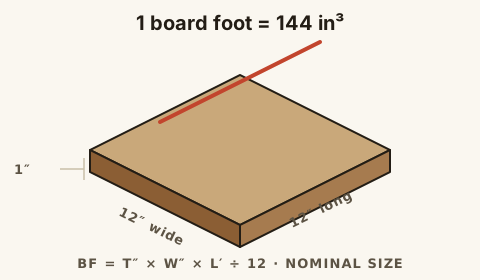
A board foot is the standard volume unit for hardwood lumber in North America: one board foot is a piece 1 inch thick, 12 inches wide and 12 inches long — 144 cubic inches of wood, as defined in the USDA Forest Products Laboratory's Wood Handbook. Sawmills, hardwood dealers and lumber yards all price rough lumber by the board foot, so knowing your project's total is the difference between a confident order and an awkward second trip.
The formula this calculator uses is the same one the yard uses: thickness (inches) × width (inches) × length (feet) ÷ 12. If your length is in inches too, divide by 144 instead. Two conventions matter:
- Nominal, not actual. A surfaced 2×4 really measures 1½″ × 3½″, but it tallies as a full 2″ × 4″. Board feet are always figured on the nominal size — that is also how the price sticker is written.
- Hardwood thickness is quoted in quarters. 4/4 (“four-quarter”) means 1″ rough, 8/4 means 2″. If a species is priced “$8.50/bf, 8/4 stock”, enter 8/4 in the thickness chip and the tally handles the rest.
Enter each board on its own line — the tally slip on the right adds everything up, applies your $/bf prices, and prints as a clean cut list you can take to the yard. Your boards stay in your browser (nothing is uploaded), so the list is still here when you come back.
Worked example
Say a coffee-table build needs two 8/4 walnut boards 7″ × 8′, and eight 4/4 maple boards 6″ × 10′. The walnut is 2 × 7 × 8 ÷ 12 × 2 = 18.67 bf; the maple is 1 × 6 × 10 ÷ 12 × 8 = 40 bf. At $11.50/bf and $7.25/bf you're looking at 58.67 bf and roughly $505 — before waste. Most woodworkers add 15–30% for defects, grain matching and mistakes; buy the extra board now and thank yourself later.
Buying tips from the tally
- Rough lumber is sold in random widths and lengths — treat your tally as a minimum and round up to the boards on the rack.
- Check the moisture content before gluing up; a pin or pinless meter pays for itself the first time it saves a panel.
- Scaling logs instead of boards? Use the log board foot calculator — Doyle, Scribner and International ¼″ side by side.
Using the board foot calculator: hardwood vs construction lumber
The same arithmetic serves two very different shopping trips, and it helps to know which one you're on.
Hardwood is where a board foot calculator earns its keep. Walnut, maple, oak and friends come off the rack in random widths and random lengths, priced per board foot by species and grade. The workflow: measure each board's rough thickness in quarters (the dealer's sticker will say 4/4 or 8/4), its width in inches, its length in feet — one line per board in the tally above, with the sticker's $/bf in the price box. The slip on the right becomes your receipt-checker at the counter; yards are honest, but tape measures and tired eyes aren't always.
Construction lumber flips the logic. A 2×4 sells by the piece, not by the board foot — yet the board footage still matters when you're comparing a framing package across sizes, pricing a big order against a mill quote in $/MBF, or figuring how a stack converts to volume. For standard sizes, skip the typing: the printable chart and the quick-answer pages (like the 2×4×8 at 5.33 bf) already hold every common answer.
Four ways a board foot tally goes wrong
- Measuring actual instead of nominal. A planed 2×4 mics at 1½″ × 3½″ — feed those numbers in and you'll under-buy by 24%. Use the nominal size; that's what the free board foot calculator (and the yard's invoice) expects.
- Length in inches, formula in feet. The ÷12 formula wants length in feet. A 96-inch board is 8 feet — enter 96 and your total quadruples into fantasy.
- Forgetting the quantity column. Eight identical shelf boards is one line with qty 8, not a mystery shortfall at the checkout.
- Confusing linear feet with board feet. Trim quoted per linear foot isn't comparable until you convert — the BF ↔ LF converter settles those quotes in one step.
Get those four right and use the board foot calculator with a 15–30% waste allowance on top, and your lumber budget stops being a guess.
Board foot calculator FAQ
How do you calculate board feet?
Multiply thickness in inches × width in inches × length in feet, then divide by 12. Example: a 2×6 that's 10′ long = 2 × 6 × 10 ÷ 12 = 10 board feet exactly.
Board feet vs linear feet — what's the difference?
A linear (lineal) foot only measures length along the board; a board foot measures volume. Convert between them with the BF ↔ LF converter — you need the board's width and thickness to do it.
Is plywood measured in board feet?
No — sheet goods are sold by the sheet or square foot. Board feet are for solid lumber. For coverage math at a given thickness see BF ↔ square feet.
How much should I add for waste?
15% for straightforward paint-grade work; 25–30% for furniture where you'll cut around knots and match grain. Rough lumber surprises you — always in the wrong direction.
More lumber calculators
Log board feet
Doyle, Scribner & International ¼″ — all three rules from one small-end diameter.
Scale a log →Printable BF chart
Every common size from 1×4 to 8×8, six lengths, one clean page for the shop wall.
Print the chart →Lumber weight
How heavy is the stack? 24 species from the USDA Wood Handbook, green or dry.
Weigh it →Hardwood prices
Reference $/bf ranges by species, and how to read a hardwood price list.
See prices →